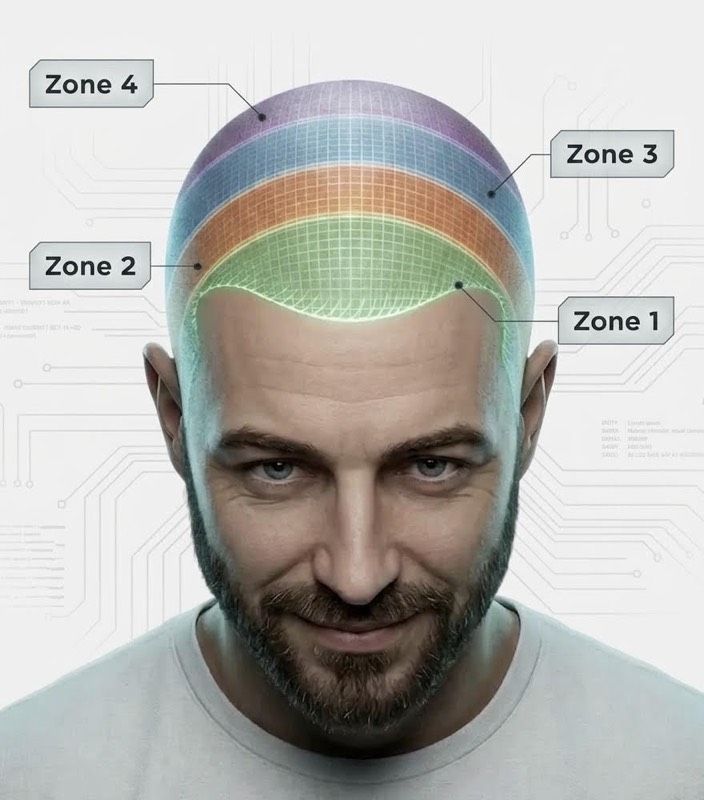
How accurate is this estimation, and can it be used as my final surgical plan?
+
This estimate is generated using an algorithm based on numerous scientific studies, as well as
clinical observations and experience. While highly reliable, an online consultation is necessary
to assess scalp laxity, graft needs, and donor density, which may lead to
minor adjustments to the final surgical plan.
Why does the result provide a graft range (e.g., 2500–3500) instead of a single fixed
number?
+
A graft range is provided because scalp size, hair loss pattern, progression
rate, donor capacity, and hair shaft thickness all influence how many
grafts are required, as well as long-term surgical planning.
Is one graft the same as one hair?
+
No. A graft is a follicular unit typically containing 1 to 4 hairs. On average, 2,000
grafts result in approximately 4,400 to 5,000 individual hairs.
How many grafts per cm² create a natural-looking result?
+
Although the literature suggests that implanting 40 to 60 grafts per square centimeter yields
positive results, a denser appearance is achieved as the number of grafts implanted per square
centimeter increases. In patients who have limited hair loss areas and good donor capacity,
densities of 60–80 grafts per cm² can be safely achieved, resulting in a significantly
denser appearance. However, if the patient has previously undergone hair transplantation or if
the donor area is limited, a lower number may be implanted. This number varies depending on
expectations, scalp elasticity, and donor sufficiency.
How many grafts can safely be taken from my donor area?
+
The safe lifetime limit for a donor area is generally 5,000 to 7,000 grafts. Harvesting
more than this can lead to cosmetic issues and overharvesting-related trauma. This figure is an
average, and the number of grafts that can be harvested may be lower or higher in some
individuals.
Is a higher graft count always better, and why do different clinics give different
numbers?
+
More isn't always better; the goal is optimal coverage without damaging the donor area. Clinics
differ in surgical philosophy regarding density and future preservation. However, in countries
where medical tourism is prevalent, such as Turkey and Mexico, some unreliable clinics
may exaggerate graft numbers to influence consumers.
How many sessions might I need based on my graft requirement?
+
According to the Norwood Hamilton scale, patients with hair loss at levels 5, 6, and 7
may require two hair transplant sessions. However, some may achieve satisfactory results after
their first transplant. Due to a limited donor area, some individuals with advanced hair loss
may not have enough grafts left for a second transplant.
Will I need additional grafts in the future as hair loss progresses?
+
Even if the transplanted grafts do not fall out, a second or even third transplant may be
necessary in areas where new bald spots form with age. It is recommended that individuals with a
weak donor area postpone surgery until the pattern of hair loss becomes clearer.
What factors determine the final price, and why are prices so different between
clinics?
+
The price is primarily driven by graft count, the surgeon's and the team’s expertise, the
reputation of the facility, and the facility's accreditation. Variability often reflects the
level of medical equipment and aftercare services included.
Do FUE, DHI, or Sapphire techniques change the cost or graft count?
+
Yes. DHI often carries a premium cost due to specialized implanter pens and higher labor.
While the graft count remains the same, the method may affect healing time and final density. It
is safer to leave the choice to a trusted doctor so they can use the method they are most
skilled at.
What does a 2000, 3000, or 4000 graft procedure usually cost?
+
Based on our calculator's regional data and clinical averages (reflecting the 2026 marginal
discount model), here is a breakdown for key destinations:
• Turkey: $2,800 – $4,500 (all-inclusive packages up to 4,500 grafts).
• United States: $8,000 – $14,000 (2,000 grafts) | $11,000 – $19,000 (3,000 grafts) | $13,000 –
$22,800 (4,000 grafts)
• United Kingdom: $7,000 – $12,000 (2,000 grafts) | $9,500 – $16,500 (3,000 grafts) | $11,400 –
$19,500 (4,000 grafts)
Is a package deal better than paying per graft?
+
Package deal prices often include the hotel, transfers, and post-procedure care. With a package,
you save approximately 500 Euros in additional hotel and transfer fees. For procedures
involving more than 3000 grafts, a fixed price is often more advantageous than charging per
graft.
Does the price per graft go down if I need more grafts?
+
Often, yes. Many clinics offer a sliding scale, reducing the unit cost as the total graft
count for the session increases.
Why is a hair transplant much cheaper in Turkey than in the UK, USA, or EU?
+
Turkey offers competitive pricing due to lower operational overheads, regional economic factors,
and specialized medical tourism incentives.
Will my personal information be shared with other clinics?
+
Your contact information will only be shared with our partner clinic, as informed while
filling out the form. Our partner clinic will prepare a detailed report for you.